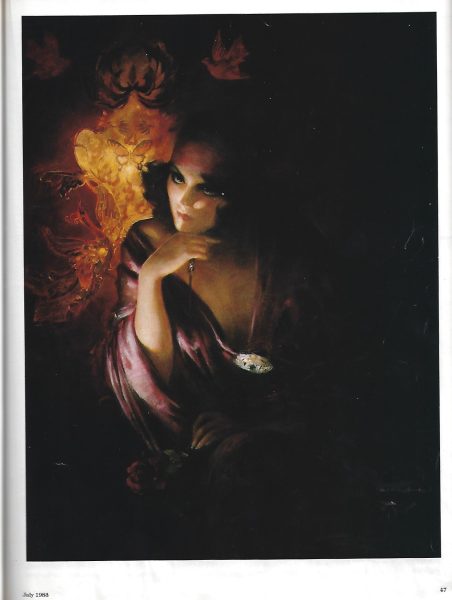
Alan Murray is a young man in search of beauty. When he began to paint seriously in 1971, beauty was frequently a dirty word. Many artists refused to paint it, the press, to use it. Never one to march with the crowd, Murray refused to be influenced by the gimmickry of those changing times; he listened to the beat of his own drum and marched on in his personal search for expression.
To achieve satisfaction through his art, he knew his subject matter must be romantic, pleasing to the eye; his color, rich but gentle; with a textural quality of satiny skin shimmering in the glow of candle- light-softness with substance. Today he has achieved that goal, but only after ex- perimenting in other fields of art, completing a two-year stint in the Army during the Vietnam War, and experiencing a brief encounter with Hollywood.
Alan Murray was born in Luton, Eng- land, in 1945. At age seven he made up his mind to become an artist, an ambition that was quickly eclipsed by the longing to become a fireman. Murray came to the U.S. by way of Saint Catharines, Ontario. The Murray family then lived in Niagara Falls for a short time, a memorable experience for young Alan because of the magnificent natural phenomenon of the dramatic falls. When he was thirteen, the family took root in the San Fernando Valley in California.
He had drawn throughout his child- hood but while attending Van Nuys High School in the Valley, even his peers began to take notice. Upon entering junior high, he joined Saturday art classes run by a married couple by the name of Samsel, who specialized in teaching pastel techniques. After only a few years of instruction he felt comfortable working in this medium. The Samsels' teaching has served him well. Although Murray has worked in many mediums, he always returns to his first love, offering a silent thank you to the Samsels, who were so thorough in the only medium they ever taught.
Alan worked constantly, and his persistence was rewarded when he entered a competition sponsored by the San Fernando Valley Art Association. He was awarded the president's trophy, the youngest artist ever to win the honor, and his painting took first prize. This and other factors encouraged him to enroll at the Art Center School of Design, in Los Angeles, following graduation from high school.
An excellent training ground for potential commercial artists, Art Center lacked the ambience suitable for a free spirit such as Murray. He found the businesslike atmosphere confining and resented the fact that male students were not allowed to have long hair nor wear sandals.
Still, Murray attempted to spread his wings in many directions. His facility as a draftsman led him to the Hanna-Barbera Studios, producers of animated film features. He began as a clean-up artist, but was quickly promoted to designing and painting the backgrounds for two popular animated film series. Yet, even "Yogi Bear" and "The Flintstones" did not intrigue him sufficiently to devote his life to working in a Hollywood studio. The experience, however, did flesh out his talents as a draftsman and introduced him to the intricacies of animated film production.
One thing he had learned during his study at Art Center was the importance of craftsmanship in art. He lost no time in filling up the six-days-a-week schedule required. Weekdays were divided between learning to paint and sharpening his skills in drawing. On Saturdays he was engaged in academic subjects.
Six months after graduation, with a B.A. degree in fine arts, he was drafted into the Army and assigned to Headquarters Company, 171st Infantry Brigade in Fairbanks, Alaska. Later transferred to Fort Wainwright, he became a draftsman, making bombing maps and allied subjects.
Appearing in the 1st Infantry Brigade News (November 30, 1968), along with a photo of Murray, were reproductions of his portraits of Army personnel, primarily officers' wives and friends, a lucrative moonlighting venture.
"Sp4 Murray," it said, "is not vocal, but best expresses his feelings with paints and artists' brushes."
But these jobs like others were stopgaps in the path of a potential classical artist. In December 1968, Murray returned home to Chatsworth, California, "one of the happiest days of my life." His determination to become a serious artist was stronger than ever before.
But late in 1970, Murray began to argue with himself about his future. "Either you're going to make it, or you're not going to make it!" was his verdict. He decided to work seriously at the thing he really wanted to do. The quest for beauty was on! The next year he began to sell a few paintings. Encouraged, he tried to interest a few galleries, and tasted the sharp bite of rejection.
In 1972 he was wearing shoulder-length hair, a thin, drooping mustache and a trailing goatee. His appearance seemed to reflect the tone of the romantic paintings he was now producing. In the meantime he had discovered Ira Roberts, a middleman who sold to galleries and decorators.
"He bought everything I produced for several years," was Murray's comment, "and I am grateful for the start this connection gave me."
Murray was right in pursuing his own direction. Viewers began to assert genuine interest in his charming children, handsome nudes, costumed ladies, and delicate florals.
His first attempts were executed in charcoal on gesso-painted boards. Effective as they were he again returned to pastel and has remained, for the most part, true to the dry-pigment chalk ever since.
Murray's first one-man exhibit was held at the A. Trebor Gallery on La Cienega Boulevard in Los Angeles. One reviewer called Murray's paintings, "... unique, haunting forms of visual communication."
After Murray's first exhibit, other showings followed in Houston, Chicago, New Orleans and at the Haggenmaker Gallery in Laguna Beach, California. Glenda Haggenmaker is that rare art dealer who truly understands the needs and potentiality of an artist. The sympathetic rapport of dealer and artist, has helped accelerate Murray's career.
In the last few years, remarkable reproductions of Murray's designs have been available in fine china plates produced by Franciscan in limited editions. In the series of six patterns titled "Little Misses, Young and Fair," the designs were planned to complement the round contours and slightly convex form of the large-size plates. HEART OF A CHILD was the first pattern produced and it created an instant demand.
Murray is realistic about the popularity of his present work. He is aware of its tremendous mass appeal and of the general interest in nostalgia. Collectors of plates, he claims, are people who want something pretty for their homes: the subjects must be happy ones, the color fresh and rather bright. One of his favorite designs was rejected by the plate manufacturer because of the child's pensiveness. One may, however, find hints of moodiness, even a touch of sadness, in some of his recent easel paintings.
At the moment he appears satisfied with his current oeuvre. But the satisfaction may not last. He is hard on himself and makes high demands.
His handsome face grows serious as he tells you, "I've done nothing really noteworthy. I believe I am ready for bigger and more important pieces. Not more and more of what they want, but more of what I want to do. I may never do anything that really satisfies me. That remains to be seen."
Alan Murray has always longed for independence. He is now able to work at his own pace, but is still not always free from pressure. He is grateful for his success and for the increasing demand for his work. Yet he longs for more free hours to bring those bigger, more important pieces to life.
He is truly grateful to everyone who has helped him along the way, but he gives his mother, Isabella Murray, most of the credit. His father, he claims, could always zero in on what was wrong with a picture, stating, "You fix it!" But he could never offer solutions.
"A long time ago Pop wanted to be an artist. But when it was decided I was to go to art school, it was my mother who made it possible. She went to work and supported me through those years so I was able to work without worrying about money. She made everything easier so I could do my best."
Murray works in a studio that was once a garage. It has been converted into a practical painting area, adjacent to his living quarters. There he houses two easels, paints reference materials, artifacts, backdrops and other miscellanea necessary for his work in various mediums.
Despite his lifelong expertise at drawing the figure, Murray still uses models when he encounters a difficult pose. One of his favorite models is his son Demian, a slender seven-year-old, by a former marriage, who is fair-headed, dark-eyed and tall for his age.
Murray is an animal lover and you may find one of his dogs snoozing on an old davenport in the studio, or a cat demanding your company. Nibbling on a plot of grass nearby is his horse.
Alan Murray relates to peace and quiet. He is not competitive; nor is he influenced by trends.
He does confess to "competing with greatness," however, saying, "I realize I am far behind, but I am constantly striving to improve and fortunately I do see progress. My reward is to know I've done good work."


 Alan Murray's painted world is a world of love and beauty, of innocence and blossoming delight. He is able to capture a mood as delicate as the features he paints on his canvas, and just as intricate.